Category: Uncategorized

  • Progress highlights at Energetik Heat Network

    Progress highlights at Energetik Heat Network


    Progress highlights at Energetik Heat Network

    We’ve seen great progress at the Energetik Heat Network site in Enfield over the last few months.

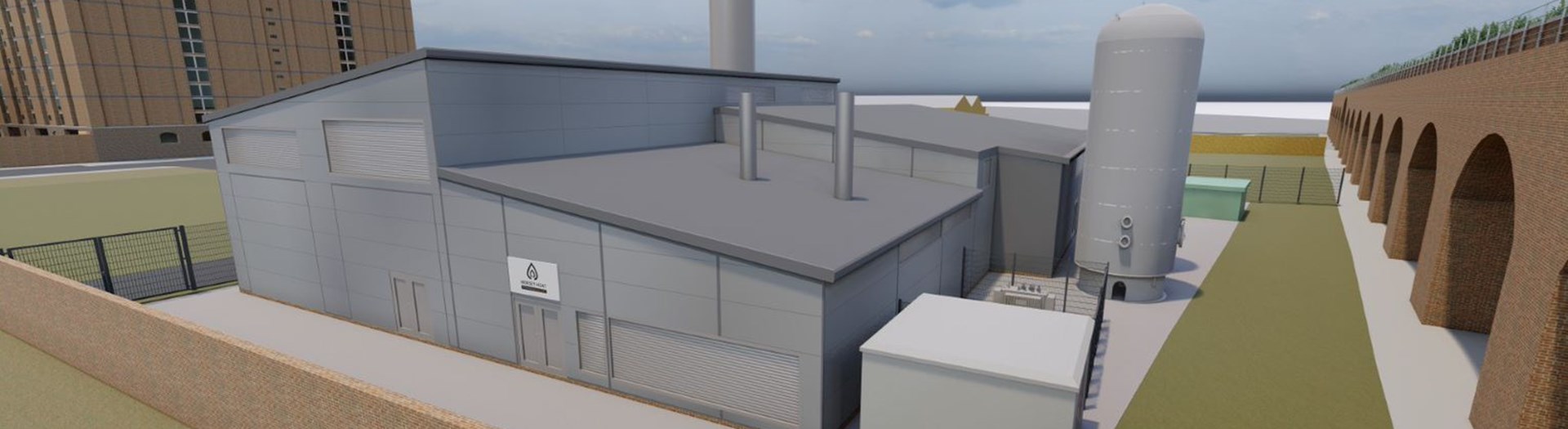
    We have completed all mechanical plant installations within the energy centre, and have progressed the primary low temperature hot water (LTHW) pipework within the boiler hall and thermal stores.

    The two 25m high, 6.6m diameter, 750,000 litre thermal stores have been subject to dosed water fill. One store has been hydrotested and we’ll soon begin the insulation process. Formation of the ground floor office area has been completed too, including the viewing deck, which will provide visitors and staff the opportunity to gain a birds-eye view of the boiler hall operation.

    Externally, the primary support work for the mesh cladding has been progressed to all elevations and the mesh cladding has commenced to the thermal store enclosure. The vertical flues have been installed within the flue tower, along with the feature lighting which will illuminate the flues.

    We have also completed the underground district heating works within the energy centre site, which is now available to connect to the future LTHW source.

    Once fully complete, this scheme has the capacity to deliver low carbon heating and hot water to tens of thousands of homes across and beyond Enfield. One of the many developments to benefit from this very-low carbon heat supply will be the 82-hectare Meridian Water development comprising 10,000 new homes, workplaces and a railway station.

    Phil Kyriacou, Senior Project Manager and Collin Miller, Project Manager tell us what has taken place so far on the project.

  • Progress at Enfield’s Energetik site

    Progress at Enfield’s Energetik site


    Progress at Enfield’s Energetik site

    We’ve reached a major milestone at the Energetik energy centre in Enfield after completing the final section of two 25m high, 6.6m diameter, 750,000 litre thermal storage vessels, where the 6t lift was suspended in position during the extensive welding process.

    Through extensive planning and scheduling, we’ve also seen the delivery and installation of some major plant items including the gas meter rig, air handling units, the chiller, and two 10MW boilers.

    Once complete, this scheme has the capacity to deliver 60MW of low carbon heating and hot water to the surrounding area, including the 82-hectare Meridian Water development comprising 10,000 new homes, workplaces and a railway station.

    ​​​​​​​Take a look at the progress pictures below.

  • Progress at Beam Park

    Progress at Beam Park


    Progress at Beam Park

    Work is almost complete at Beam Park, where we’ve designed and installed an energy centre to supply sustainable heat and power to 1,200 homes, and we’ll soon be handing the keys over to our client, Countryside.

    We have installed all plant and equipment within the Energy Centre which includes 2no Bosch CHP and 6no Hoval gas fired boilers, LTHW and gas pipework. Flues have been installed to above roof level in Block L, in which the EC is situated (12 stories high), ventilation has 4no supply fans and 2no extract fans which have been ducted to their positions.

    Electrical power is now available to BMS panel and is allowing commissioning of the system. Pumps, pressurization unit and Vacuum Degasser have now been commissioned, and supply and extract fans have been wired and are due to be commissioned next week.

    Michael Davidson, Senior Project Engineer at Beam Park, said:

    “This has been a really enjoyable project to work on, and we have a great relationship with the client. We hit a few bumps in the road in relation to the distribution network operator suppliers of gas and power, but we’re back on track and are ready for the boiler and gas commissioning in mid-November.”

    Fun fact – located in the London Boroughs of Barking and Dagenham and Havering, the Beam Park site is the former home of one of the largest car plants in the world. It was also used for a dress rehearsal of the opening ceremony of the London 2012 Olympic and Paralympic Games and formed the backdrop for the popular British film ‘Made in Dagenham’.

    We’ve secured phase 2 of the project where work will begin soon – watch this space!

  • Powys Teaching Health Board Prescribe £4.2m In Energy Upgrades

    Powys Teaching Health Board Prescribe £4.2m In Energy Upgrades


    Powys Teaching Health Board Prescribe £4.2m In Energy Upgrades Across 12 Healthcare Facilities

    Powys Teaching Health Board (PTHB) are undertaking a £4.2m energy revolution at seven of their hospitals which will see their carbon emissions reduced by an estimated 350 tonnes per year.

    The project is possible due to funding from the Welsh Government.  The project is set to significantly reduce energy consumption, lower carbon emissions, and improve the overall environment for both patients and staff.

    Measures undertaken will include:

    • Installation of roof-mounted solar panels
    • Upgrades to building management systems (BMS) for enhanced remote monitoring and heating control
    • Improvements to roof and pipework insulation
    • Implementation of LED lighting systems
    Brecon War Memorial

    Brecon War Memorial Hospital – One of the Health Board’s facilities which will benefit from the energy upgrades

    Solution detail

    This significant investment from Welsh Government for the Re:fit Cymru framework will act to enable energy efficiencies and deliver decarbonisation benefits across the Health Board estate in Powys. We look forward to working closely with Vital Energi in this exciting programme of activity, which will improve patient and staff environments, make an important contribution towards meeting the organisation’s Decarbonisation Strategic Action Plan objectives and make financial savings.”

    Wayne Tannahill – PTHB, Associate Director of Capital, Estates & Property

    About The Project

    In addition to strong carbon savings, the energy reductions will deliver over £415,000 in savings and Vital Energi are providing an energy performance contract, which guarantees key performance indicators such as carbon and energy savings.

    Mark Williams, Partnerships Director at Vital Energi, expressed enthusiasm for the project: “By partnering with Powys Teaching Health Board through the RE:FIT framework, Vital Energi is implementing guaranteed energy conservation measures that deliver both financial savings and significant carbon emission reductions. Together, we’re paving the way for a more sustainable healthcare system in Wales.”

    The energy efficiency improvements will be implemented across twelve key healthcare facilities in Powys, including:

    • Breconshire War Memorial Hospital
    • Bronllys Hospital
    • Bro Ddyfi Community Hospital
    • Knighton Community Hospital
    • Llanidloes War Memorial Hospital
    • Welshpool Health Clinic
    • Ystradgynlais Community Hospital

    Work is scheduled to commence in December and continue until July 2025, with a phased approach across the specified sites.

    This is an exciting collaboration between Vital Energi, Powys Teaching Health Board, and the Welsh Government which demonstrates a shared commitment to creating energy-efficient, environmentally friendly healthcare facilities that benefit both patients and the planet.

  • Powering Futures: Bringing Solar Energy to Local Schools

    Powering Futures: Bringing Solar Energy to Local Schools


    Powering Futures: Bringing Solar Energy to Local Schools

    As part of our commitment to protecting our planet for future generations, we have donated 112 solar panels to two schools; Meadowhead Community Infant School and Turton and Edgworth Primary School.

    These schools are at the heart of our community, and by investing in them today we’re powering futures and sparking a lifelong passion for sustainability.

    To mark the launch, senior figures from across the company, including the engineers who designed the scheme, visited both schools to explain to children aged between 6 and 12 how solar technology works and to inspire pupils about green careers and the opportunities within the energy sector. The sessions highlighted the importance of collaboration and innovation in tackling climate change.

    We believe that by engaging young people today, we can help them grow up with an understanding of renewable energy and the role they can play in shaping a sustainable future.

    Watch the videos below and hear from the pupils at each of these schools about what they learned…

  • Plymouth advance towards net zero thanks to new partnership with Vital

    Plymouth advance towards net zero thanks to new partnership with Vital


    Plymouth’s journey to net zero progresses thanks to new partnership with Vital Energi

    Vital Energi are helping Plymouth City Council achieve their goal of a net zero city by 2030 by delivering carbon savings of just under 300 tonnes a year through the installation of advanced renewable energy technologies across five of their buildings and the combined law courts.

    Low carbon heat will be delivered to six of Plymouth’s key city centre buildings, including Ballard House, Plymouth City Council’s 7-storey head office, Crownhill Court, Grade II* listed Victorian townhouse, Elliot Terrace, and the Guildhall, which is a Grade II listed building owned by the council, linked by a heat network to the Council House and Plymouth Combined Court. This is part one of a larger programme of decarbonisation by the Council.

    The buildings currently rely on individual gas fired boilers for heat, which release combustion gases and carbon emissions to the atmosphere via a flue in each building. Vital Energi are providing the complete design, supply, delivery, installation, testing, commissioning, and monitoring for the installation of Air Source Heat Pumps (ASHP) which will be connected to the existing heating system.

    ASHPs are one of the most effective technologies for reducing carbon. They absorb heat from the outside air, transfer it to a liquid and compress it to heat the temperature further.  The heat is then transferred from the liquid to water and distributed throughout the network to provide heat to the connected buildings. ASHPs can still extract heat when air temperatures are as low as -15°c, which is far lower than Plymouth ever gets!

    Vital Energi are also undertaking alterations to parts of the heating system pipework and controls within the existing building; this is to reduce the heating system operating temperatures to support the lower optimum ASHP operating temperatures and maximised efficiencies.

    All four sites will be remotely monitored via a building management system (BMS) too, so performance can be monitored over time and amendments can be made to controls settings and software remotely.

    Rob Callaghan, Managing Director of Vital Energi for the London and Southern Division, said:

    “We are grateful to Plymouth City Council for giving us the opportunity to work in the team that is focused on carrying out this important retrofitting work to Plymouth public sector estate.”

    “This is a huge step forward in plans to tackle the climate crisis and I’m really pleased we’ve been able to secure the funding. I know that for a lot of people out there, the Council changing how it heats its buildings isn’t ground-breaking news. But for us, it’s about setting an example.”

    Councillor Maddi Bridgeman, Cabinet member for the Environment & Street Scene

    This project, which provides further opportunities to extend a heat network within Plymouth city centre as a comprehensive redevelopment programme to serve other developments in the future, received grant funding from the Public Sector Decarbonisation Scheme (PSDS), which is administered by Salix on behalf of the Government’s Department for Business Energy and Industrial Strategy (BEIS).

  • Plans approved for pioneering Warrington carbon-capture facility

    Plans approved for pioneering Warrington carbon-capture facility


    Plans approved for pioneering Warrington carbon-capture facility

    Planning permission has been granted for a state-of-the-art new carbon-capture facility at Lingley Mere business park in Warrington.

    The project, Mersey Biochar, will lock away thousands of tonnes of carbon a year into biochar, a versatile product with a range of uses from improving soil quality to decarbonising the construction industry. Led by climate-action organisations Severn Wye Energy Agency and Pure Leapfrog, a consortium of experts is behind the project which will be hosted by United Utilities at Lingley Mere business park. Construction is due to begin in November, with the unit supplied by PyroCore and the facility built by energy specialists Vital Energi.

    Capturing carbon and other greenhouse gases will be critical for the UK’s plans to meet net zero by 2050 and the facility promises to make an important contribution to the country’s carbon-capture potential.

    Vital Energi’s Associate Design Manager Rob Greenwood, says:

    ‘We are delighted to be part of the consortium which will deliver this innovative new project. With the UK set to continue using oil and gas in the short term, carbon capture has the potential to play a huge part in the UK’s transition from fossil fuels to a net zero economy and this project can demonstrate an innovative new application for an existing, trusted technology.’

    Mersey Biochar represents an important step forward in the UK’s carbon-capture ambitions and getting planning permission for the Lingley Mere site is an exciting start. We hope to prove this technology can be used across the UK to help tackle climate change

    Sandy Ruthven, Severn Wye CEO

    Mersey Biochar will capture carbon from green waste or ‘biomass’, in this case a byproduct of local forestry management, which would otherwise release its carbon back into the atmosphere as it decays. The carbon is locked in through a process called pyrolysis, which heats the biomass in a virtually oxygen-free environment without the noise or fumes commonly associated with other types of burning. The resulting biochar stores the carbon for centuries and every tonne produced can remove up to 3.6 tonnes of CO2 from the atmosphere. The facility is expected to produce 700 tonnes of biochar each year.

    Research into the viability of the process was funded by the UK government’s Department for Energy Security and Net Zero which then made a further £5m available to scale-up the concept as part of the Carbon Capture Utilisation and Storage Scheme.

    Receiving planning permission is a significant moment for this project. As we continue along our planned product development pathway, we will see this unit, and more like it in the future, making important contributions to the UK’s carbon capture and storage needs. This technology has an exciting and valuable future.

    Paul Gilligan, CEO – Pure Leapfrog

    Planning permission was secured by integrated planning, design, environment, engineering and safety consultancy Mabbett & Associates Ltd, with no objections to the proposals.

    The approval of planning permission for the Warrington site is just the start of this exciting project. The vision for the site is that nothing will go to waste; once the facility’s carbon-capture capabilities are proven, the heat generated by the process is intended to be redirected to heat and power United Utilities’ buildings – part of the company’s long-term sustainability goals.

    As United Utilities’ Bioresources and Green Energy Director, Tom Lissett, explains:

    ‘We are excited to host this innovative technology which opens up the opportunity to decarbonise our office heating requirements at Lingley Mere by capturing and using the heat which is created during the pyrolysis process. It is an important step forward for us in our journey to decarbonising our head office in Warrington.’

    Mersey Biochar is funded by the UK’s Department for Energy Security and Net Zero through their Direct Air Capture and Greenhouse Gas Removal innovation programme, established to find new and inventive ways of reducing UK carbon emissions.

  • Plans approved for Liverpool energy centre

    Plans approved for Liverpool energy centre


    Energy Centre Liverpool

    Plans for an energy centre in Liverpool with renewable technologies to help provide low carbon heat and hot water to residents and businesses have been approved by Liverpool City Council yesterday(16 February).

    The Peel NRE facility between Great Howard Street and Sherwood Street is expected to save around 4,200 tonnes of carbon per year, this will be achieved through the primary use of water source heat pumps and thermal stores to provide heat to Peel NRE’s Mersey Heat district heat network.

    It includes plans for two 3MW water source heat pumps which would work on an ‘open loop’ system to take heat from water abstracted from the Leeds/Liverpool canal before pumping it back into the dock system.

    Two thermal stores capable of holding 260 cubic metres of hot water will also be installed alongside heat only gas boilers with a combined capacity of up to 40MW as a backup, and for use during times of peak demand.

    The energy centre will provide heat for up to 9,000 homes and 4 million sq ft of commercial space at Peel L&P’s Liverpool Waters development, it will also connect to other key developments in the area.  The project is part funded by the Merseyside Pension Fund.

    The Mersey Heat Network is a major part of Liverpool’s developing low-carbon infrastructure and Peel NRE receiving planning permission for this new facility is fantastic news. The energy centre will be instrumental, not only to the network’s immediate success connecting new developments, but also to its continued expansion. The project has been future proofed with the capability to connect to existing city centre buildings, so that it can meet the long-term decarbonisation goals of Liverpool.

    Mike Cooke , Vital Energi Managing Director, North & Scotland

    This new facility will use renewable technologies as the main energy source to generate heat for the Mersey Heat network and connect homes and offices to low carbon heat and hot water. We’re pleased to receive planning permission for the energy centre to help meet national and regional climate emergency targets and we will explore options to decarbonise the network further as and when new technology develops.

    Jonathan Burley, Peel NRE Commercial Director

  • My reflections on another successful Vital Energi event.

    My reflections on another successful Vital Energi event.


    Pixar’s philosophy, sexy pipes, and making friends and keeping them friendly – my reflections on another successful Vital event.

    Pixar’s philosophy, sexy pipes, and making friends and keeping them friendly – my reflections on another successful Vital Energi event.

    By Abby Whitelock, Marketing & Communications Director

    Now that the dust has settled, the pop-up banners stored away and the superb food we were served fully digested, it’s time to reflect on an enormously successful ‘Future of Energy’ event in Glasgow.

    Feedback about the event has been glowing, with attendees describing the event as “illuminating”, “relevant”, and “engaging”. None of this would have been possible without our “impressive” line-up of speakers who truly brought the day to life, and the incredible delegates who engaged with the event so brilliantly.

    Session one was all about the future of our industry, a Q&A hosted by the University of Strathclyde’s Amy Ritchie who interviewed three future energy champions: Vital Energi’s own Caitlin Villanueva, Jack Ord from STAR Refrigeration, and Ricardo’s Aniruddha Chhatre.

    Hearing how the next generation views the energy industry through its unique lens was fascinating and informative. Young people clearly want to know the real world impact of the work they’re doing and value a company which embraces flexible working. A lack of role models in the industry stood out as a key message for me, as well as the need for big business to work more closely with secondary and higher education bodies to ‘sell’ a career in green energy. Caitlin who, like me, is a member of the District Heating Divas, talked eloquently about the need for companies to consider the physical work environment for women in particular (e.g. providing PPE that actually fits!) and the danger of unconscious bias in job adverts.

    Next up, my colleagues Nick Gosling and Scott Lutton hosted a session on the minefield that is unlocking funding and commercial support for heat networks. The discussion centred around potential solutions to overcome the barriers, such as the need for increased regulation to build customer confidence, enhanced statutory powers, and greater public awareness of the benefits the sector offers.

    Of particular interest were the comments made by Colin Hudson of the National Wealth Fund (NWF). Colin provided key insights into the NWF’s core sectors to target, which include digital & technologies, advanced manufacturing, and transport. With a £5.8 billion budget set to be deployed across carbon capture, port infrastructure, green steel, green hydrogen, and gigafactories over the course of this Parliament.

    Vital Energi has first-hand experience of the benefits an institution such as the NWF bring to communities. Recently, the NWF issued funding to its first heat network project in Solihull, which Vital Energi will be designing and building. Knowing support like this exists is essential to businesses like ours, impatient to drive change in a market which is quite risk adverse.

    In session three, I was intrigued by Ross Ramsay from the Scottish Futures Trust who said more companies could benefit from the philosophy of animation giant Pixar. It believes that “you get great creative people, you bet big on them, you give them enormous leeway and support, and you provide them with an environment in which they can get honest feedback from everyone”. The point really is you empower people to take risks, to push barriers, and you don’t crush them if they get it wrong. Ross also emphasised the importance of “making friends and keeping them friendly”, stressing that strong relationships are crucial for overcoming challenges in a project. It was great to hear from Vital’s friend, Ener-vate’s Steve Hunt, and I did chuckle when Sarah-Jane McArthur from Brodies described lawyers as “the project prevention unit”.

    Next, Polly Cook from Leeds City Council and Rhea Marsden from the SWAN Heat Network talked us through the Leeds PIPES project and the large new heat network in Westminster. SWAN will see heat captured from innovative sources such as the London Underground, the Thames, and the sewer network, becoming one of the UK’s first heat network zones. The Leeds PIPES heat network is an innovative and reliable district heating solution that brings heat and hot water into taps, radiators, and heating systems to over 2,500 buildings and residences. It currently uses heat created as a by-product of burning Leeds’s non-recyclable waste. Both are Vital projects, of course, and both show the sort of innovative thinking we’re famous for.

    Finally, it was my turn. Together with Tanita Addario from Aberdeen City Council, we started by asking what ‘Social Value’ and ‘Community Benefits’ meant to the audience. It’s clear those phrases mean different things to different people, but the two words that came up more than any others were education and engagement.

    For me, the Torry Heat Network project in Aberdeen, on which we were the main contractor, is an exemplar of best practice here. What we learnt from it was to engage early and consult, take people on the journey with you. To achieve this, your messaging must be tailored to the specific people you are speaking to. All our promotional material, published long before spades went in the ground, was produced in three languages to speak to the diverse Torry community and included a direct point of contact for enquiries. And we listened, understanding that in an area of high poverty, heating costs were a key concern. The crucial task of stakeholder mapping helped us to understand the community’s worries, allowing us to address them in our communications and alleviate any concerns.

    We also went into local schools with our STEM-approved ‘Climate Education Programme’ to try and inspire and educate young people about, yes you guessed it, the future of energy.

    Jessica Cooke, Senior Planner at AECOM wrote on LinkedIn that it was “a pleasure to attend” the conference and added “The renewable energy sector is indeed at an exciting juncture!”

    Rhea Marsden, Head of Connections at SWAN Heat Network, wrote, “events like this are a great reminder that the industry is heading in the right direction”. And Dr Roddy Yarr, Director of Sustainability at the University of Glasgow and Associate Director of the Centre for Sustainable Energy, was very complimentary, writing “Vital’s can-do and approachable attitude continues to deliver positive impact.”

    If you want to join us at one of our future events, email [email protected] to be placed on a waitlist.

  • Paul Younger Energy Centre Takes Shape

    Paul Younger Energy Centre Takes Shape


    Paul Younger Energy Centre Takes Shape

    South Tyneside Council have set ambitious carbon targets of net zero carbon in operations by 2030 and one of the projects which will be driving those emission reductions is the Hebburn Renewable Energy Scheme.

    The Paul Younger Energy Centre which supplies the heat network, is currently starting to take shape, with the steel framework installation progressing well. The building will house a two stage 450kw air to water source heat pump solution which will take ambient heat from the air and convert it into low-temperature-hot-water to provide reliable, lower carbon heating.

    Air source heat pumps used for the scheme minimise the use of traditional, gas-fired boilers, which will enable the project to deliver carbon savings of approximately 319 tonnes per year.

    The build of the energy centre follows the completion of the district heating network infrastructure installation and connection works for residential development Durham Court, and Hebburn Central leisure centre, over the past 18 months, with plans for more buildings to be added in the future.

    The building is named after Professor Paul Younger, one of the region’s pioneering scientists, who played a key role in the bid to make Newcastle a City of Science and Technology.

    The project is due for completion by the end of 2023.