Blog

  • ESCo: A Q&A with Paul McIver

    ESCo: A Q&A with Paul McIver


    ESCo: A Q&A with Paul McIver

    Community Energy Director, Paul McIver, is responsible for developing Energy Services Company (ESCo) opportunities for Vital Energi that will contribute to a low carbon future, and play a pivotal role in the UK’s energy transition and net zero carbon agenda.

    We asked Paul some questions about the benefits of an ESCo, how Vital can help with ESCo advice and support or act as the ESCo for your project, and he shares some examples.

    What is an ESCo?
    An Energy Service Company (ESCo) is the company that owns the assets and is responsible for generating, supplying, and managing energy to homes and properties. They take a project, and efficiently make use of the assets over and above that of distributed systems. By way of competitive fuel procurement, lower running costs, lower capital costs and reduced carbon emissions, end users benefit from competitively priced heat, cooling and hot water delivered directly to their premises. ESCo services can support a range of mixed-use developments, from a regeneration area or a large residential development, to a hospital or multi-unit development of retail outlets.

    What are the benefits of an ESCo?
    A key benefit is that an ESCo takes on financial risks, therefore minimising risks to clients. They also take the technical and operational risks too, as they optimise and manage the lifecycle of the assets.

    Heat, cooling, and hot water is provided directly to properties from low-carbon energy generation equipment often located within the development. This enables consumers to benefit from avoided costs associated with energy supplied via national distribution networks. It also means properties do not require individual boilers, saving space within the property and avoiding any boiler maintenance and lifecycle replacement costs.

    What is Vital Energi’s ESCo offering?
    With over 30 years’ experience in the design, build, operation and maintenance of district energy projects in the UK, we have proven in-house expertise to deliver the full range of ESCo services with the highest level of customer service. We recognise that heat needs to play a key part in decarbonisation therefore we will adopt and own these assets to get projects off the ground to help achieve our net zero targets. Delivering low-carbon, affordable energy to end-users is an integral part of what we do here at Vital, and so we have dedicated teams that focus on decarbonisation and create new and innovative ways to decarbonise new and existing schemes, helping local authorities, cities and organisations on their journey to net zero.

    What are the key considerations people should consider when selecting an ESCo?
    ESCo experience is key, so it’s important to find out what kind of experience the business possess in terms of delivery of design, build, operate, maintain, and finance of residential or mixed use developments.
    An ESCo that is credible, collaborative, flexible and has integrity, by protecting customers from artificially inflated charges, that works with the procurement process, and takes on the negotiation and adoption of the assets are key considerations too, failure of which can lead to costly legal and delay costs being incurred.
    High standards of customer service. This may seem obvious, but ultimately, the customer is left with the ESCo as their quasi-utility provider. There is a general misunderstanding of what a heat network is and what it means to a customer, so the ESCo has an obligation to ensure the customer is educated. This might be by way of literature or face to face meetings. It is essential that high standards of customer service can be evidenced.
    An ESCo that commits. As contracts typically last for 25 years or more, the ESCo must maintain their initial levels of commitment to the project for the entire project lifecycle, always keeping the end customer at the heart of all that they do.

    How do you procure an ESCo project?
    Depending on the organisation procuring an ESCo, public procurement (OJEU), competitive tender, frameworks (such as Fusion 21), or direct award may be utilised to procure the ESCo.

    How can an ESCo support social housing providers and developers?
    The ESCo should possess the expertise to provide a comprehensive service, encompassing initial feasibility and financial viability studies, provision of finance for projects, system design, installation and commissioning, and project management of associated works. They’ll also be responsible for the ongoing operation and maintenance, and contract energy management.
    By working in partnership with local authorities, social housing providers, and developers, an ESCo should be able to provide bespoke, outcome-based solutions that address each town, city, region or developments’ most pressing needs, improving efficiency, driving down costs and reducing CO2 emissions. The ESCo’s activities should be designed to make a real difference to the lives of the customers.

    Can an ESCo provide funding towards a scheme?
    In simple terms yes. There are various funding options available, from Government backed schemes that usually provide match funding to the ESCo providing a share of the asset value (a capital contribution). Each scheme is evaluated on its own merits to ascertain what, if appropriate, the correct route to funding may be.

    Can you share some examples of projects where Vital is the ESCo?
    We’re acting as the ESCo on number of projects. Examples include:

    • We’ve been the ESCo at The Movement since 2013 in a 35 year contract. It’s a 2.2 acre mixed use development in Greenwich, comprising 539 homes, and a 358 room hotel.
    • The H2010 development at Yarn Street, where we were appointed to deliver and operate a low carbon community energy scheme to new 315 homes at the heart of the new Aire Valley “eco-settlement” area of Yorkshire in a £14m contract, which began in 2018.
    • The Paintworks was originally an old paint and varnish factory which has been thoroughly transformed into a living and working community in the heart of Bristol. In 2016, we were appointed to design and build the community energy scheme and provide 30 years of on-going energy supply and services as the ESCo on the .




  • Candid Conversation… Results and Resilience

    Candid Conversation… Results and Resilience


    Candid Conversation… Results and Resilience

    A-Level Results Day can feel like the moment that shapes your entire career but at Vital Energi, we know it’s just the beginning.

    Kieran Walsh, Regional Manager (North & Scotland) and Alex Marshall, Associate Design Director, started their careers on very different paths. Neither followed a straight line to success, but both have built thriving careers in the UK’s low-carbon energy industry.

    In this video, they share real-life career advice for school leavers, apprentices, and graduates,  from overcoming self-doubt to seizing opportunities. If you’re wondering how to build a career you love (no matter your grades), check out their video below:

  • Vital completes major roof-mounted solar at iconic Glasgow landmark

    Vital completes major roof-mounted solar at iconic Glasgow landmark


    Vital Energi completes major roof-mounted solar array at iconic Glasgow landmark

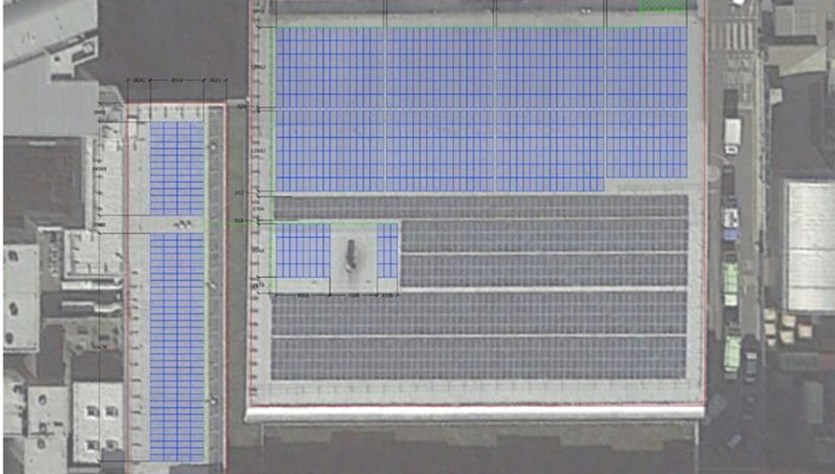
    Vital Energi has successfully completed a flagship roof-mounted solar project at Glasgow’s historic Kelvin Hall. The landmark project for Glasgow City Council, featuring over 1,000 solar panels and worth approximately £1.5 million, demonstrates Vital Energi’s growing presence in Scotland’s renewable energy sector and its capability to deliver complex technical solutions in challenging built environments.

    The ambitious project at Kelvin Hall is a key part of Glasgow City Council’s climate action strategy. It is designed to significantly reduce carbon emissions, supply approximately 20% of the building’s annual electricity needs, and generate £182,000 in electricity savings each year.

    The installation is accompanied by seven smaller solar installations across Glasgow schools and daycare centres, collectively supporting the city’s journey toward net zero emissions.

    Working on Kelvin Hall’s protected Category B listed structure presented unique engineering challenges. Our team developed custom mounting solutions for the distinctive barrel-shaped roof while preserving the building’s historic character. This required specialised safety systems for installers working at height and strategic relocation of inverters to optimise system performance. We considered more than just the technical aspects of the project—we actively engaged with the community to ensure the voices of those affected by potential disruptions were heard and respected.

    Scott Lutton, Regional Director at Vital Energi

    Beyond its environmental impact, the project has delivered significant community benefits, including educational initiatives and employment opportunities. Glasgow-based contractor, Versatile, was engaged for the installation, supporting jobs in the city’s East End. The project has also included classroom presentations on climate action for local schools through our Climate Education Programme, and is providing raised plant beds, soil and plants for community gardens at the daycare centres involved in the wider scheme.

    The project adds to the 46 renewable energy installation projects that Vital Energi has delivered to date across Scotland, which include recent solar projects for NHS Lanarkshire and NHS Tayside. The company installed the landmark Queens Quay Heat Pump scheme in West Dunbartonshire in 2019. This is the largest water-source heat pump system in the UK, which extracts heat from the River Clyde to provide low-carbon heating to over 1,200 homes and businesses.

    The solar project was 50% funded by Salix Finance, with Glasgow City Council providing the remaining investment.

  • Humber hydrogen project submitted for government phasing competition

    Humber hydrogen project submitted for government phasing competition


    Equinor submits flagship Humber hydrogen project for government phasing competition

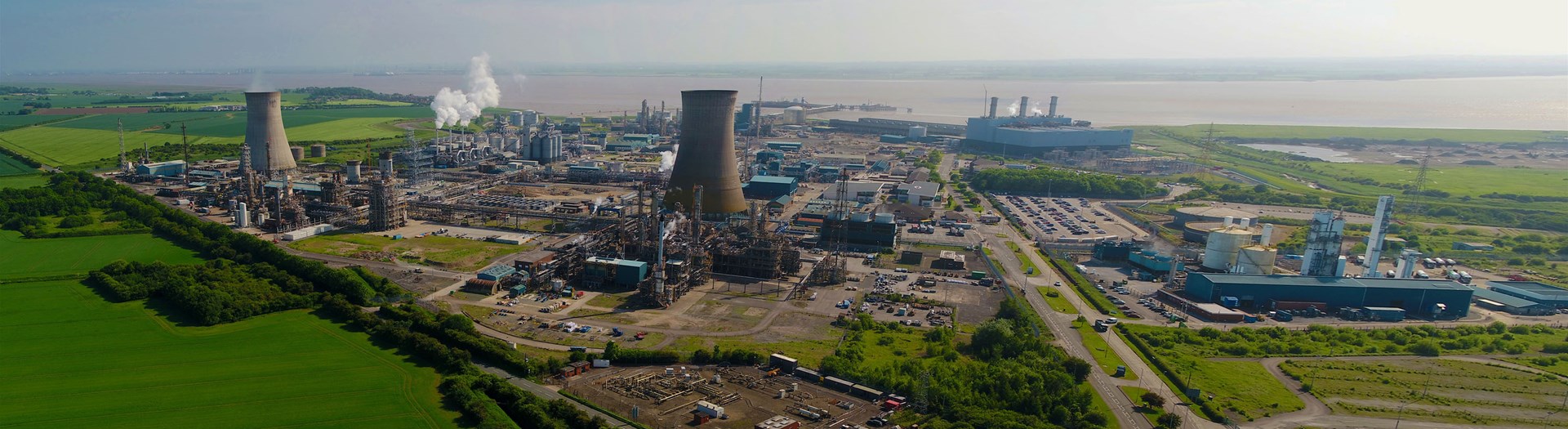
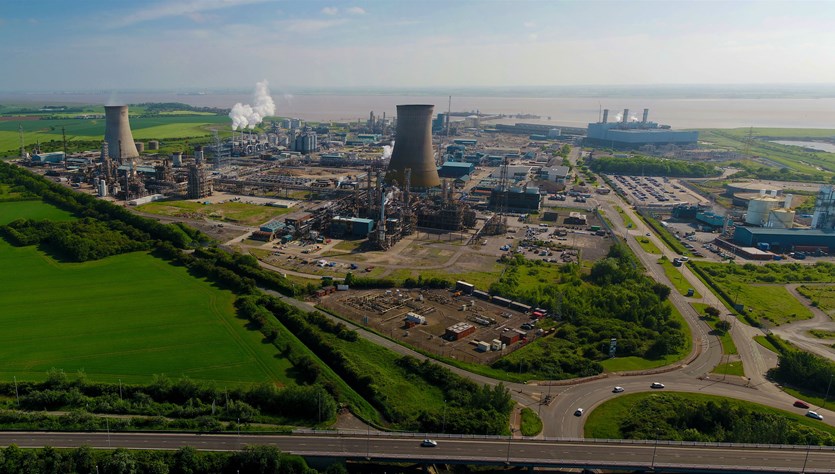
    Equinor has formally submitted plans for its ‘Hydrogen to Humber (H2H) Saltend’ hydrogen production facility into phase two of the Government’s Cluster Sequencing Process, supported by a series of co-operation agreements with prospective regional hydrogen users, which could be a world first and a catalyst for the Humber to achieve net zero.

    H2H Saltend is Equinor’s flagship 600 megawatts low carbon hydrogen production plant with carbon capture, located in Saltend, to the east of Hull. The Humber region is the most carbon intensive industrial cluster in the UK and H2H Saltend could enable industries at Saltend Chemicals Park and the East Yorkshire area to reduce CO2 emissions by nearly one million tonnes annually, representing a 30% reduction in the Saltend Chemicals Park’s total current emissions.

    The plan is backed by six prospective industrial operators who have signed varying agreements for the development and commercialisation of the project, including potential future hydrogen supply. Fuel switching from natural gas to low carbon hydrogen would support decarbonisation of the Humber region and further accelerate the development of what could be a world first-of-a-kind hydrogen value chain project.

    • Centrica Storage operates the Easington gas storage site in East Yorkshire and offshore platforms in the North Sea. Fuel switching from gas to hydrogen can help to reduce its emissions at Easington.
    • INEOS Acetyls supplies chemicals for a wide range of downstream industries such as food, pharmaceuticals, paints, adhesives and packaging from its site at Saltend Chemicals Park. Using hydrogen instead of fossil fuels within its processes can reduce its emissions and produce lower carbon chemicals for wider use in the economy or for export.
    • Pensana is in the process of establishing the UK’s first independent and sustainable rare earths processing facility at Saltend Chemicals Park. This will support a range of industries vital to meeting the country’s Net Zero ambitions, including Electric Vehicles and offshore wind. Utilising Hydrogen in the processing of end-of-life permanent magnets allows low energy recovery of the critical rare earths to be reused in this important supply chain.
    • Triton Power operates Saltend Power Station, currently natural gas-fired and providing power and steam primarily to the Chemicals Park. By switching from fossil fuels to low carbon hydrogen it can accelerate the decarbonisation of the Park and its other users.
    • Vital Energi is the energy services provider to the Yorkshire Energy Park, a proposed energy and technology park located within the Humber Freeport Zone. Using hydrogen within its electricity generation, heating and cooling can contribute to a low carbon park facility, helping to attract environmentally conscious companies.
    • Vivergo Fuels is a renewable bioethanol fuel producer based at Saltend Chemicals Park. Its bioethanol will be blended with petrol to create E10 fuel, when the plant reopens in early 2022. They will be collaborating with Equinor on assessing the potential for hydrogen to be used as a low carbon fuel alternative to natural gas within the drying of its co-produced animal feed.

    Beyond these initial off-takers, the low carbon hydrogen could also be used much wider, helping to decarbonise multiple sectors such as heavy industry, transport, heating and pharmaceuticals across the Humber region.

    The submission has also been accompanied by 23 letters of support from organisations across the region including MPs, local authorities, LEPs, business and trade bodies, educational institutions and diversity groups.

    It also coincides with the signing of an agreement with px Group, owner and operator of Saltend Chemicals Park, confirming the project location.

    H2H Saltend is the kick-starter project for the wider Zero Carbon Humber scheme, a UKRI-supported partnership of twelve organisations committed to making the Humber the world’s first net zero industrial cluster by 2040.

    It is also the essential building block for Equinor’s ‘Hydrogen to Humber’ ambitions which seeks to establish at least 1.8 Gigawatts of production in the region by 2030, over one third of the Government’s UK-wide target. In partnership with SSE Thermal, Equinor is planning to develop the world’s first at-scale 100% hydrogen power station at Keadby in Lincolnshire and a proposed hydrogen storage facility at Aldbrough in East Yorkshire. In partnership with gas distribution network operator Cadent, Equinor recently announced plans for potential hydrogen town trials in northern Lincolnshire, in line with the Government’s ambition to decarbonise domestic heating.

    In October the Department for Business, Energy and Industrial Strategy (BEIS) announced that the East Coast Cluster, of which Zero Carbon Humber is the largest regional industrial cluster, was one of two successful national bids in Phase One of its Cluster Sequencing Process. This allows individual decarbonisation projects within the cluster to enter Phase Two. Submissions closed on 21st January and a result is expected around May 2022.

    Equinor has also submitted three other projects into the process. These include two new carbon capture power stations at Keadby and Peterhead, both developed together with SSE Thermal, as well as the Net Zero Teesside Power project which is developed in partnership with bp.

    Dan Sadler, Vice President for UK Low Carbon Solutions at Equinor, said:

    “We are delighted to submit our formal plans to Government for our flagship H2H Saltend project, as well as three other low carbon projects across the UK. This shows the strength of ambition from Equinor in the UK, building on its considerable experience of similar projects internationally.

    “H2H Saltend is an exciting ground-breaking project which will provide low carbon hydrogen to multiple industries in the Humber by 2026, and the demand for this is clear from the industrial operators’ agreements we already have in place. Importantly, it is also a major step to a wider hydrogen economy which can reduce emissions across several sectors, act as a catalyst for greater inward investment and economic growth, and working with our partners, also ultimately result in a Zero Carbon Humber.”

    Quotes from off-takers

    Martin Scargill, Managing Director of Centrica Storage Limited, said:

    “Centrica are the UKs largest energy supplier and we are committed to being a net zero business by 2045 and helping our customers be net zero by 2050. Fuel switching our operations at Easington to Hydrogen would provide a unique opportunity to make a step-change reduction in our emissions, whilst also paving the way to provide large-scale, flexible, low carbon energy storage solutions for the UK “

    David Brooks, CEO of INEOS Acetyls, said:

    “As a business with a long tradition of developing lower carbon solutions, INEOS Acetyls is proud to back Zero Carbon Humber’s efforts to build the world’s first net zero industrial cluster and help make the region competitive for generations to come. At INEOS, we believe that achieving net zero by 2050 is only possible by significantly increasing the use of hydrogen, making the H2H Saltend project a critical component of the cluster strategy.”

    Paul Atherley, Chairman of Pensana, said:

    “We are establishing a world-class, independent and sustainable, rare earth processing facility at the Saltend Chemicals Park. We are also looking to process end-of-life magnets from wind turbine nacelles using an innovative hydrogen decrepitation process. We very much look forward to working with Equinor using hydrogen from the H2H Saltend project, not as a fuel, but in establishing this innovative process route as a key component in the circular economy for rare earth magnets in the UK.”

    Mick Farr, President of Triton Power, said:

    “Triton Power’s highly efficient Combined Heat & Power (CHP) Power Station at Saltend stands ready to convert to a Hydrogen blended fuel, and ultimately to accommodate 100% Hydrogen.

    “This will significantly reduce CO2 emissions from thermal power generation, which remains a vital component of the varied energy mix needed to enable security of supply through the energy transition; providing power when renewables are not generating, and grid stability when they are.

    “We believe this low-risk conversion project utilising proven technology can be the key enabler to kick-start a world leading UK hydrogen economy, and to decarbonize the hard to abate industrial consumers of our power and steam at the adjacent Chemicals Park.”

    Nick Gosling, Chief Strategy Officer of Vital Energi, said:

    “Vital Energi is an energy generation, distribution and supply company with over 30 years’ experience.  Vital has been selected as the energy services provider by Hull Eco Park Limited (the developer of the Yorkshire Energy Park).  Yorkshire Energy Park is a new development located in the East Riding of Yorkshire, which has a vision to become one of the first zero carbon business parks in the UK, providing up to 2,090 full time jobs when fully operational.  The park’s energy centre will use hydrogen as a fuel to generate the majority of the low carbon electricity, heat and cooling needs of the park customers.”

    Ben Hackett, Managing Director of Vivergo Fuels, said:

    “Vivergo Fuels will be one of Europe’s largest bioethanol producers when we re-open our plant in early 2022, and we are looking forward to collaborating with Equinor to assess the potential use of hydrogen as a low carbon alternative fuel to natural gas at our plant.”

  • We’re Proud to be in Lancashire’s Top 100!

    We’re Proud to be in Lancashire’s Top 100!


    We’re Proud to be in Lancashire’s Top 100!

    We’ve been named 11th on the Top 100 privately-owned companies in Grant Thornton’s first ever Lancashire Limited 2025 report.

    Whilst this report recognises business performance, it’s also about celebrating the incredible collective impact that Lancashire’s companies have on our communities, our economy, and our future.

    How these businesses are impacting Lancashire:

    • The Top 100 companies generate a combined turnover of £11.5bn and employ nearly 60,000 people across the region, driving opportunity, innovation, and prosperity for all.
    • Lancashire is leading the way in energy transition, tech, advanced manufacturing, and sustainability, helping to build a greener, more resilient future for the entire UK.

    At Vital Energi, we’re passionate about creating sustainable energy solutions, but we’re just one part of a vibrant, ambitious business community. Every company on this list, from family-run enterprises to fast-growing innovators plays a vital role in:

    • Creating quality jobs
    • Investing in local talent
    • Supporting regeneration and community initiatives
    • Inspiring the next generation of leaders

    We want to say a huge thank you to our amazing staff, clients and partners and congratulate our fellow Lancashire businesses on making the list and making a difference!

  • Royal Shrewsbury Hospital breaks ground on major decarbonisation project

    Royal Shrewsbury Hospital breaks ground on major decarbonisation project


    Royal Shrewsbury Hospital breaks ground on major decarbonisation project

    Work has officially begun on a £16.2m project at Royal Shrewsbury Hospital (RSH) which will see the installation of heat pumps, solar panels and energy efficiency measures to reduce the site’s carbon footprint by over 3,000 tonnes a year.

    The Shrewsbury and Telford Hospital NHS Trust, which runs RSH, secured funding through the Public Sector Decarbonisation Scheme, and has partnered with Vital Energi, who have developed the scheme.

    The project is being delivered through the Carbon and Energy Fund (CEF) Framework, which has been specifically created to fund complex energy infrastructure upgrades for public sector organisations

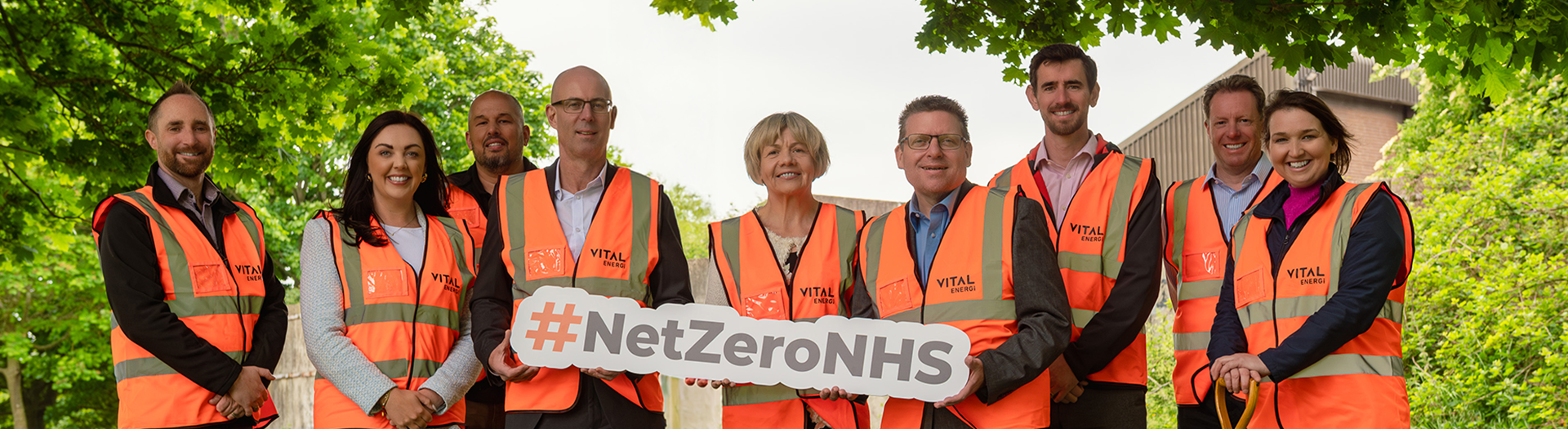
    Key members of the team from the Trust, Vital Energi and the CEF came together to mark the start of the works on site.

    By replacing the old steam boilers and associated gas-fired equipment with a 1.6MW air and water source heat pump system, buildings across the site will receive low carbon heating, hot water and chilled water. It will mean the hospital estate will be fully de-steamed.

    Rooftop solar panels will also be installed along with the upgrade and optimisation of the building energy management systems, upgrades of roof and pipework insultation and the replacement of air handling unit fans units with low-energy fan systems, which will reduce the site’s energy consumption and improve the patient and staff experience.

    When the work is complete, the investment could save the Trust an estimated £1 million a year in energy costs and will support the Trust’s Estates Decarbonisation Strategies, Green Plan and national NHS ambitions of reaching net zero by 2040.

    “It is wonderful that the work has commenced on this sizeable project, which will see the site cut its carbon footprint by over 3,000 tonnes a year. We are committed to supporting greener solutions across both our hospital sites. Starting this work means that we are a step closer to our vision of creating more modern facilities and sustainable health services. This will be of benefit to our patients and colleagues.”

    Inese Robotham, Assistant Chief Executive of the Trust

    Phil Mottershead, Project Development Director for Vital Energi, said:

    “Today marks an exciting milestone as we officially break ground on site, following months of dedicated planning and close collaboration with the Trust. This ambitious project not only brings the hospital closer to achieving its net zero goals, but also promises to significantly enhance the experience for patients, staff, and visitors alike.”

    Dominic Clarke, Project Manager for the Carbon and Energy Fund (CEF) commented:

    “The CEF is proud to support the Shrewsbury and Telford Hospital NHS Trust in achieving its carbon reduction targets. This initiative is being delivered through a PSDS Phase 3C grant, secured via the Department for Energy Security and Net Zero (DESNZ) and Salix Finance.

    “Working alongside delivery partner Vital Energi, the project focuses on the electrification of the hospital’s heating systems, aligning with the NHS’s target of reaching Net Zero by 2040.”

    The project received grant funding from the Public Sector Decarbonisation Scheme (PSDS), which is administered by Salix on behalf of the Government’s Department for Energy Security and Net Zero.

  • Vital Energi secures PSDS 4 funding for projects worth £68m

    Vital Energi secures PSDS 4 funding for projects worth £68m


    Vital Energi secures PSDS 4 funding for projects worth £68m

    In the latest round of the Public Sector Decarbonisation Scheme (PSDS), Vital Energi has supported clients across the country to fund renewable energy and heat network projects totalling £68m, accelerating their journey to net zero.

    Vital Energi has successfully guided eight clients through the Phase 4 application process, securing £55.6m in funding for their projects. Including previous rounds of PSDS, this brings the total funding they’ve secured to an impressive £337.6m.

    Clients in this round are from the healthcare, local authority, and transport sectors, and these groundbreaking projects will generate combined annual carbon savings of almost 8,500 tonnes, and over £1m in energy savings each year.

    The projects will harness the latest technology and include energy solutions such as large-scale heat pump systems, the connection of existing public sector buildings to heat networks, solar PV, and a host of energy conservation measures, from LED lighting upgrades to pipework insulation.

    This latest round of PSDS funding is a testament to the power of collaboration and innovation in leading the transition to a low carbon future. By helping clients secure £55.6m for decarbonisation projects, we’re not just supporting our clients to meet their decarbonisation targets, we’re accelerating the UK’s transition to a net zero future. These projects will deliver lasting environmental and financial benefits, and we’re proud to play a key role in shaping a more sustainable public sector.”

    Phil Mottershead, Project Development Director at Vital Energi

    PSDS is a UK government initiative that provides grant funding to public sector organisations for energy efficiency and low carbon heating measures in their buildings. Administered by Salix Finance, the scheme aims to reduce carbon emissions from public buildings by 75% by 2037.

    PSDS 4 further advances the government’s net zero and clean growth ambitions by prioritising funding for decarbonisation projects where heating systems are nearing the end of their operational life and require replacement.

    Vital Energi has the in-house capability to complete feasibility studies, surveys and data analysis required to develop a qualifying scheme. They have the expertise to optimise the solution to ensure the project has the best possible chance of securing grant funding, and self-deliver the construction, operation, and performance guarantee over the lifetime of the asset.

    PSDS is just one of the many funding pathways Vital Energi can support you with. If you’re planning a decarbonisation project, get in touch by emailing [email protected] 

  • A new era for heat: Queens Quay heat pump

    A new era for heat: Queens Quay heat pump


    A new era for heat: Queens Quay Heat Pump System

    A first for the UK – A new way of generating heat

    Queens Quay 25

    While there is considerable enthusiasm for large-scale water source heat pumps for new-build projects, they aren’t always considered as suitable for retrofit buildings with traditional secondary side heating systems. With correct design, however, they are an intelligent solution for most projects or – as in the case of the Queens Quay project, commissioned by West Dunbartonshire Council – a mixture of new-build and retrofit connections.

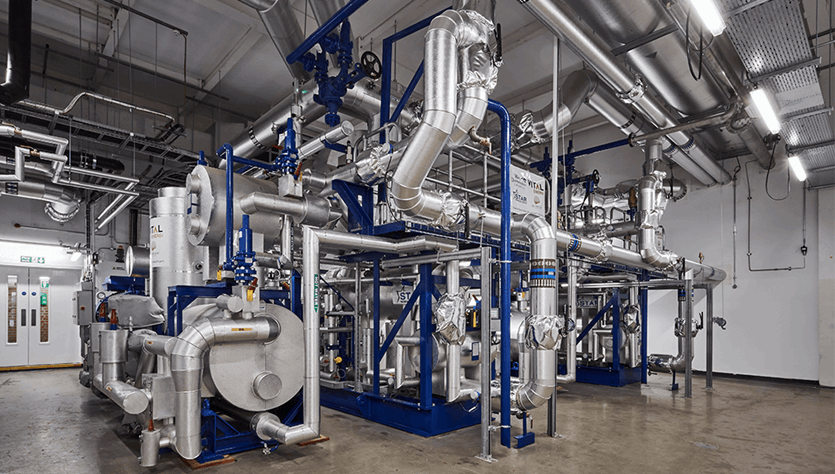
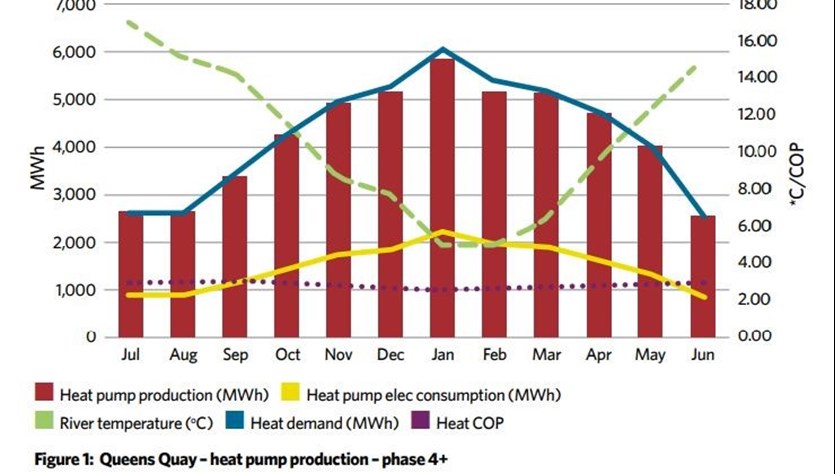
    The Queens Quay energy solution has two 2.65MW ammonia water source heat pumps, built by Star Refrigeration, and a 130m3 thermal store at the heart of the low carbon system. This provides around 80% of the 51,000MWh annual heat demand, with the remainder supplied by backup, gas-fired boilers. There is also scope for two heat pumps to be added as the build out progresses and the heat demand increases.

    The colourfully lit chimney contains the heat pump ventilation system and includes the emergency ammonia purge system, which ensures there is adequate dispersion and no impact on locals in the event of a leak. Three boiler flues also terminate in the chimney.

    A riverwater abstraction system has been installed at the Queens Quay Basin, which takes water from the river Clyde and circulates it through the heat pumps, before returning it to the river, with a stipulation that it cannot be returned more than 3K cooler than its original abstraction temperature.

    The heat pump converts the latent heat from the river into low-temperature hot water, which is distributed via a 1.5km district heat network serving the 23-hectare development. It will eventually serve 1,200 homes, and the associated infrastructure needed to support them, such as health centres and commercial facilities.

    Solution detail

    Delivering a hybrid district heating system

    Vital Energi Energy Generation Banner 2021 Queens Quay (1)

    While the heat pumps were capable of supplying heat at 80°C+, there was strong motivation to lower the low-temperature hot water (LTHW) flow temperature as much as possible, because every 1K reduction resulted in an increased heat-pump efficiency of 1.5%. This created a dilemma for the designers, who would need to keep temperatures relatively high to meet the needs of the existing buildings, but low enough to get maximum efficiency from the pump.

    Historical heating systems served by gas boilers operate on 82°C flow and 71°C return temperatures, meaning primary flow temperatures of up to 90°C are commonly used in district heating schemes to satisfy this requirement across a hydraulic break, such as a plate heat exchanger.

    A detailed review of the existing systems concluded that these buildings can operate at 75°C flow and 60°C return, while new buildings have been designed to operate at 70°C and 45°C return. Weather compensation can reduce summertime temperatures for further efficiency benefits.

    The flow temperature has to be high enough to meet the needs of the four retrofit buildings but, as these constitute 10% of the demand, they don’t influence the overall network distribution temperature too much and we can still prioritise overall system efficiency.

    If the balance of loads tended towards a higher retrofit percentage, then the reciprocal would be true. However, reduction in temperature via weather compensation is important to ensure the system can satisfy the domestic hot-water production, as well as any specialist needs, such as healthcare pasteurisation.

    With this blend of new-build and retrofit, our designers achieved a coefficient of performance of 3.1, making it considerably more efficient than traditional solutions, such as gas-fired boilers or combined heat and power.

    Solution detail

    Building the data model

    Queens Quay Pump Delivery 115

    Initially, the development had the following anchor-load buildings: the Aurora Building, Clydebank College, Titan, a leisure centre and the Queens Quay Care Home. It will create new-build properties, such as 1,200 homes, but there is an opportunity to incorporate significant existing building stock going forward.

    Predicting the energy demands of a development is difficult, but necessary because it dictates the sizing of the plant, equipment and district energy network. For new-build connections, understanding the heat demand based on building designs is relatively straightforward – by looking at U-values, for example – but occupants can use energy in a variety of ways, which affects their annual energy demand and profile.

    Energy data for existing buildings is seldom available in the granularity required to build detailed energy profiles, so calculations often incorporate experience to find a solution with inherent flexibility that can deal with all possible scenarios.

    Understanding peak loads to size energy-centre plant is something all district energy designers must consider. The real challenge, however, is understanding the diverse energy profiles across the network to select the most appropriate water source heat pump and thermal storage, to achieve a significant heat fraction.

    This means accurately predicting the energy demands for all connected buildings, plus the diversity across the network. Without these, the water source heat pump could have been sized incorrectly: too large and it would not operate efficiently; too small and the carbon savings would not be achieved.

    Solution detail

    A flexible solution

    Graph

    Designing new buildings and properties to connect to a district energy system, which operates at lower temperatures, is relatively straightforward. Building Regulations have helped reduce the heat losses from buildings by improved U-values and lower infiltration rates – all of which means thermal comfort can be achieved with lower temperatures.

    Existing buildings, particularly ageing ones, usually have higher heat losses and infiltration rates, so higher temperatures are required to achieve the same thermal comfort levels.

    Connecting these buildings to a network with lower operating temperatures can only be done after a full evaluation of space-heating emitters – such as radiators, fan coil units and air handling unit coils – to ensure heat losses are achieved.

    While it wasn’t necessary on the Queens Quay project, improvements to building fabric, such as insulation and replacing single-glazed windows with double-glazed ones, can help with reducing heat losses and is often a sensible place to start.

    Often, older LTHW systems have constant-volume pumps controlled via 3-port valves. This can lead to high return temperatures to the energy centre and to the system not performing as designed, or turning off. This, in turn, can result in increased network losses and higher contribution from gas-fired boilers.

    Converting these 3-port systems to 2-port ones, employing pressure independent control valves, ensures good control and low return temperatures, although there will generally need to be a change in pump-control philosophy, from constant volume to variable volume, often requiring the introduction of inverters to all pumps.

    Another consideration is domestic hot water. CIBSE/Association of Decentralised Energy Heat network code of practice (CP1) has recently reduced the temperature required within residential properties.

    However, commercial and healthcare buildings have different temperature requirements and these influence the minimum network temperatures. This is particularly applicable to the summer operating condition, ie the minimum weather compensated temperature.

    Solution detail

    A heat pump-ready HIU

    Queens Quay Vtherm 051

    Many traditional heat interface units (HIUs) do not have the ability to operate efficiently at lower temperatures. While the Queens Quay development would have flow temperatures of up to 80°C, this would be a rarity, and in the warmer summer months – when there is little heating demand – it would be dropped as low as 60°C.

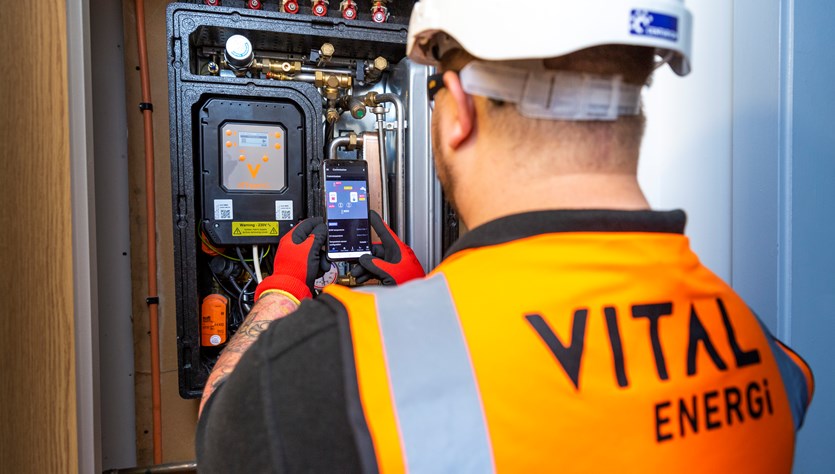
    To deliver efficiency over these parameters, it was necessary to design a heat pump-ready HIU, with an intelligent core, that could monitor the changes in flow temperature and the domestic hot-water temperature, and compensate to ensure optimum performance.

    Vital Energi spent two years developing the vTherm°e HIU to meet these requirements. While it was designed with the next-generation district heating systems in mind, it can perform efficiently at higher temperatures.

    This, combined with its ability to react to temperature changes, means it will stay optimised as the flowrates change throughout the season, giving real-time optimisation to the project.

    Ian Spencer, associate design director, says: ‘Reduced temperatures mean reduced losses – and, while losses created by an individual HIU are comparatively small, when you multiply this by 1,200 and operate them over a 20-year period, it can deliver significant savings in operating costs and carbon.’

    If you’d like to learn more about the energy management system at Queens Quay you can read the case study here.

    Solution detail

    Retrofit and new-build performance

    A review of a building’s energy system is essential to understand the changes needed to make it compatible with a lower-temperature district energy system. This, combined with a survey of historical energy consumption, begins to paint a picture of what is necessary, but historical oversizing of heat emitters and antiquated controls systems can actually provide a benefit, as they reduce the need to change the secondary side heating system.

    Improved standards and advances in technology mean buildings that are only years old can compare poorly in relation to current buildings. The Queens Quay development has buildings that are a few decades old, but because of their fabric construction and existing heating system design, we need to be able to deliver flow temperatures of 80°C and return temperatures of 60°C.

    On the new buildings, where we can have an input on design, we can deliver 70°C flow and 45°C, resulting in lower temperatures and a higher temperature differential.

    Retrofits require more consideration in the design process, but we believe Queens Quay demonstrates that heat pumps are viable for buildings of all ages. Lowering temperatures, while improving insulation, emitters and controls, can be an extremely efficient energy solution.

    If you’d like to learn more about the Queens Quay energy project then please visit our case study page here.

  • Vital is decarbonising Islington Waste Recycling Centre

    Vital is decarbonising Islington Waste Recycling Centre


    Vital is decarbonising Islington Waste Recycling Centre

    Vital Energi have been awarded the £3m contract by Islington Council to help decarbonise Islington Waste Recycling Centre through the implementation of heat pumps and solar, which will significantly reduce the site’s carbon footprint and accelerate the Council’s journey to net zero by 2030.

    Recycling around 55,000 tonnes of household waste each year, Islington Waste Recycling Centre (IWRC) is one of the six recycling and reuse centres in North London that offers its residents a vast range of recycling opportunities. It is also one of the largest contributors to London Borough of Islington’s gas emissions, accounting for 10% of all gas consumption across 55 the Council’s corporate buildings.

    Vital Energi will be replacing and upgrading some of IWRC’s existing equipment to renewable technologies and carrying out roof repairs to the Tipping Hall and adjacent office, using the most advanced polymer systems, which will help them become more energy efficient.

    We will install 944 solar panels with solar edge optimisers to the north half of the main tipping hall roof and the entire office roof, doubling the capacity of the existing PV system.

    Artist’s Impression of Solar Car Port Design

    0793Adec Afa0 4562 920B 64Ff67236cfd

    Solution detail

    Mechanical and electrical works required to be carried out by Vital Energi include the refurbishment of the existing six Air Handling Units (AHUs) by replacing the existing gas fired heating coils with electric and refrigerant coils including associated condensers and ancillary equipment. The existing two Direct Gas Fired Domestic Hot Water (DHW) generation system in the main hall plantroom will also be replaced with an air-to-water source heat pump DHW system.

    The existing LV electrical infrastructure will be upgraded to supply the new mechanical equipment being installed. These works include construction of a new LV switch room. Installation of lighting, power, containment, fire alarm and protection services for the new LV switch room which is in the basement of the recycling centre.

    Vital Energi always strive to deliver social value within the communities in which they’re delivering projects and have a series of initiatives planned to give back to the Islington community. Initiatives include sponsoring local under 14s and under 12s girls football teams and holding a tournament with a family fun day theme. The Vital Energi team are actively involved with local businesses to develop a supply chain within the community, and they will also host various classroom tutorials on working within the industry.

    “We are delighted to be helping Islington Council take significant steps on their decarbonisation plan, making Islington Waste Recycling Centre more sustainable and accelerating their journey to net zero. The installation of the heat pumps and solar panels is an innovative move to help transition into a low carbon centre.”

    Rob Callaghan, Managing Director, Vital Energi’s London Division

    The project received grant funding from the Public Sector Decarbonisation Scheme (PSDS), which is administered by Salix on behalf of the Government’s Department for Business Energy and Industrial Strategy (BEIS)

    Work has commenced on-site.

  • Government backs major London heat network as £21m grant funding given

    Government backs major London heat network as £21m grant funding given


    Government backs major London heat network as £21m grant funding awarded

    Today, the Department for Energy Security and Net Zero has awarded £21m to the South Westminster Area Network (SWAN). This major infrastructure project is set to slash carbon emissions and improve air quality in Westminster.

    SWAN, which will drive £1bn investment into the capital by 2050, is progressing, with construction planned to start next year. This investment will drive growth across Westminster and create a wave of high-quality jobs in the local area.

    Today, the SWAN Partnership, who are developing the heat network, have provided a first look at the scheme.

    SWAN will develop out from two centres, one around the Strand, and one around Millbank and St James’ Park. Buildings in these areas can connect to the heat network from 2028.

    To accelerate development of the scheme since they took on the role of developer in September 2024, the SWAN Partnership has engaged over 170 buildings in the Westminster area. Most of these buildings are now working through the process to get planned into and connected to the network.

    Several landmark buildings are planning to connect to the heat network, including Somerset House and the London Transport Museum. These buildings have set ambitious plans for decarbonisation which they will put into action. By working together and with the SWAN team, organisations like this are making the heat network a reality, helping to save carbon, improve air quality and drive growth into Westminster.

    “It is great to see some of central London’s most well-known buildings taking this step on their decarbonisation journey. Heat networks have an important role to play in helping London achieve net zero carbon by 2030 as we continue working to build a better, greener London for everyone.”

    Mete Coban, Deputy Mayor of London for Environment and Energy

    “SWAN has the potential to support decarbonisation of historic buildings in central London, providing some of Westminster’s most recognisable landmarks with clean heat. This will help us to meet the target of becoming a net zero carbon city by 2040 and achieving World Health Organisation guidelines for air quality.”

    Adam Hug, Westminster City Council Leader

    “Heat networks will play an important role in our mission for clean power by 2030, helping us to achieve energy independence and lower bills. “That is why this government is backing inventive projects, such as using heat generated by sewers or the River Thames to provide heating to connected businesses and homes, through the Green Heat Network Fund.”

    Miatta Fahnbulleh , Minister for Energy Consumers

    “Westminster is showing a voracious appetite for clean, decentralised heating. We find organisations who are committed to decarbonising, reducing air pollution, and doing this in a way that is sensitive to the heritage of the area. Using the Thames as a heat source allows us to invest in infrastructure that provides buildings access to the locally wasted heat resource, without individual buildings having to invest in complicated, visually disruptive solutions to decarbonise their heating.”

    Toby Heysham, Director, SWAN

    The intended heat source for the first phase of the network will be natural heat from the River Thames. A water source heat pump would recover energy from the river to generate heat for the network. The heat pump then uses electricity to upgrade the temperature of that heat to around 80oC. For the buildings in the area, this is a big benefit, because many of their systems already operate at around 80oC meaning that the swap to low carbon heat is easier.

    The team behind SWAN has identified and worked up a number of heat source options which will be brought forward over time to allow the network to expand. This includes looking at other waste heat sources such as heat from the tube and the sewer. Over time the network will expand to serve the whole zone, including, eventually, some homes.

    The £21m grant funding announcement by DESNZ will support the development and construction of the heat network, helping make the network more affordable for customers. Funding is provided by the Green Heat Network Fund which is administered by Triple Point Heat Networks Investment Management.

    Buildings within or near the area are being encouraged to join the network by emailing [email protected] to request an Indicative Connection Offer.

    “Low carbon heat networks will be essential infrastructure to decarbonise heat in dense urban areas, and SWAN represents an ideal opportunity to show case this at scale. Our teams are actively exploring a range of low carbon heat generation technologies and energy centre locations, and we look forward to sharing more information on our trail blazing a solution as it becomes available.”

    Nick Gosling, Director, SWAN

    “Somerset House Trust is committed to reducing its carbon footprint and demonstrating that heritage buildings can be sustainable when equipped with the right technologies. SWAN aligns perfectly with this vision by providing a low-carbon heating solution where more conventional options are limited.”

    Jonathan Reekie, Director of Somerset House Trust

    “We are delighted DESNZ has committed funding to support SWAN. This significant grant award in the scheme and the interest from landmark buildings across the district shows what can be achieved by working together to drive decarbonisation and innovation, in even the most traditional settings.”

    Ruth Duston, CEO, London Heritage Quarter